Better soil health translates to less diesel use
Uncertainty over the war in Iran and its impact on fuel prices prompted south-central Nebraska farmer Jordan Uldrich to buy diesel in bulk.
Normally he buys as he needs it, but watching the price climb from $3 to $4.50 per gallon as the war goes on, he decided to secure 3,000 gallons before the number got any higher. That should get him through most of the year.
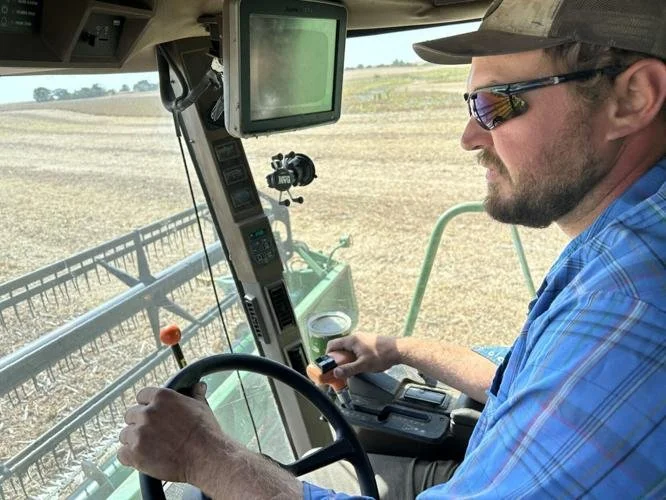
Jordan Uldrich combines soybeans. He was pleased to see that a dryland field of beans yielded well after a rye cover crop, even despite receiving little rain in September.
Submitted photo by Kerry Hoffschnieder
He’ll soon be burning through some of that supply as the planter gets rolling, but irrigation is the big diesel user on the Uldrich farm. He calculates the cost of pumping an inch of water over an acre. When diesel was closer to $2.50 per gallon, irrigating his fields cost him about $6.50 an acre. Now, it will cost nearly twice that.
One factor on Uldrich’s side is the soil health he’s built up in his fields. Healthier soils allow for better water infiltration and storage.
“If you can capture those rainfalls … that’s less money you have to spend to keep your crop alive,” he said.
Last year, he applied 3.5 inches under his pivots when some of his neighbors with conventional farms put on 5 or 6 inches.
“I’ve noticed we don’t irrigate like the neighbors do,” he said.
His farm near Milligan received 1-1.25 inches of much-needed rain in late April.
“That was very welcome,” he said.
Cold temperatures kept him from planting until May. The thermometer dropped below freezing a few consecutive mornings as April came to a close. Uldrich will grow shorter season corn and soybeans this year.
“We’re not late yet,” he said. “It’s kind of nice not being in a hurry.”
Judging by the forecast for early May, he expected to be rolling by May 3 or 4.
Uldrich terminated cover crops on dryland fields to keep them from using soil moisture before the cash crop goes in. Other covers, such as long on irrigated soybean fields, he’ll let grow until June.
“What we’re trying to do there is feed the biology and keep it moving,” he said of the role cover crops play in soil health.
His cattle herd is grazing other covers as they continue to calve. Calving was about three-fourths done as of May 1.
Jordan Uldrich is a fifth generation on his Fillmore County farm, working with his dad and brother to raise conventional corn, soybeans, milo and rye and a small beef herd. He has adopted regenerative practices, including interseeding cover crops and rotational grazing. Jordan is a board member and has one of the demonstration-education sites for the Nebraska Soil Health Coalition.