
Monetizing the benefits of building soil health
By Janelle Atyeo, Midwest Messenger Editor
Late last June, Zach Mader’s farm north of Grand Island soaked in a 7-inch rain overnight. It left parts of the city under water, but it didn’t stop Mader from his work.
The next morning, he walked through his fields as planned to sample the nutrients in his corn crop.
“I could walk anywhere and I didn’t leave a track,” he said.
Years of building up healthy soils created a structure beneath his feet. His soils are porous enough to let rainwater soak in. High organic matter helps stabilize soil aggregates, keeping particles in place when water and wind want to erode the earth.
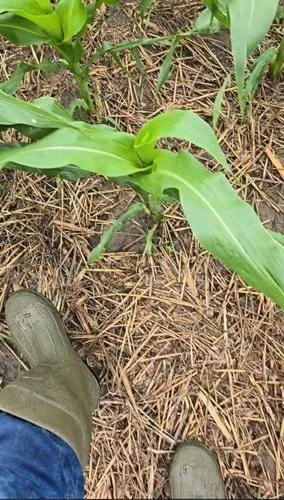
Zach Mader walks through his corn field after a 7-inch rain last June without making tracks. “I believe this is a prime example of how soil health pays,” he said.
Mader, a producer lead for the Nebraska Soil Health Coalition, knows there’s more value in those healthy soils than just the ability to work after a rainstorm. To help quantify that value, the coalition teamed up with the Soil Health Institute on an economic analysis of farming and ranching using soil health management systems.
The Soil Health Institute surveyed producers in south central Nebraska about their farming practices and finances. A report highlighting results from the first 20 interviews was recently published online. A link is available on the coalition’s website, nesoilhealth.org.
The report put a dollar value on improved water infiltration like Mader sees in his fields. On average, farmers using soil health practices used less irrigation water, to the tune of 3 inches an acre, compared to a conventionally managed field. Growing irrigated corn cost $91 per acre less, and soybeans cost $48 per acre less to grow.
Yields improved, too, according to the report. Soil health management systems increased corn production revenues by an average $53 per acre, and soybeans brought another $43 per acre.
The survey considered the expense of fertilizer, pesticides, fuel, labor and equipment ownership. It contrasted the savings of using non-treated seeds ($7.87 per acre for corn) with the added cost of buying cover crop seed ($9.33 per acre). On the revenue side, soil health practices brought a yield bump worth $11.80 per bushel in irrigated corn and another $14.39 per acre from grazing cover crops. As it all shook out, net farm income increased by $152.92 per acre for growing irrigated corn.
“It’s pretty clear if you can invest in your soil and treat it like an asset that can be improved, it will improve and it will make you more profitable,” said Jordan Uldrich, a producer from Milligan and member of the Nebraska Soil Health Coalition board.
The study aims to give producers information about the economics tied to soil health management so they can make solid business decisions. It does so by collecting real data from farmers who have been using long-term no till management, planting cover crops, growing diverse rotations and integrating livestock on the landscape.
It’s helpful to put a number to the benefits those soil-friendly farming practices provide, Mader said.
“I think it’s a selling point of why you should consider some of these practices,” he said. “It’s data we can use to say, ‘this actually works.’”
He’s cut down his herbicide bill substantially. Having a diverse rotation and growing four to six different crops each year, he raises some crops that don’t require herbicide. He also has a weed barrier in the mat of cereal rye residue into which he plants his corn crop.
Integration of livestock opened new revenue streams for Mader. Turning cattle out to graze cover crops makes better use of his land, which would otherwise sit idle after the cash crop is in the bin. It also allows him to keep roots in the ground through more of the year, improving the soil biology.
For the survey, Mader participated in a two-hour interview covering the details of his farming practices. He discussed the different crops he raises, what he spends on inputs, how many head of cattle he grazes and for how long. They’re all numbers most farmers have at their fingertips, he said, and he doesn’t worry about sharing the details for the greater good. Results are aggregated, and while survey participants get a report from their own farm, individual data is kept private.
“This is a very safe space,” Mader said of the soil health coalition. “This data is for all of us to share and collaborate with.”
The Nebraska Soil Health Coalition funded the study, in part through grants. The North Carolina-based Soil Health Institute has done similar surveys elsewhere, but Nebraska’s is the first statewide effort and the first in an area where irrigation and livestock grazing are common practices.
“We’re looking at comparing different regions in the state to monetize soil health’s return on investment,” said Mike McDonald, Nebraska Soil Health Coalition Board treasurer.
A total of 35 interviews were done in the soil health coalition’s Hub 1 in south central Nebraska. They’ve now expanded into Hub 2, in southwestern Nebraska, where another 45 producers will participate.
The Soil Health Institute report can help landlords, lenders and farm managers get a better feel for what soil health practices do, McDonald said. Ultimately, the practices a farmer takes on has to be economically viable.
The coalition is connecting producers interested in building soil health. It hosted a producer-to-producer event Feb. 23 with about 35 farmers and ranchers in attendance. They broke out into small groups based on interest – grazing, nutrient management and interseeding. Those clusters with a common interest will meet in the future. Gatherings will happen less often during the busy growing season, aside from a demonstration site visit, tentatively scheduled for July.
“We can have some really collaborative conversations,” Mader said.
‘Round the NSHC Coffee Pot is a monthly feature special to the Midwest Messenger. It highlights the work of the Nebraska Soil Health Coalition, a nonprofit organization established in 2023 to advance producer-centered education, outreach, and the adoption of soil health principles to build resilient farms, ranches, and communities across Nebraska.