
PART 1: "A Tale of Two Farms: Two Generations, Two Approaches"
MEDIA CONTACT:
Casey Hoins, Nebraska Soil Health Coalition Coordinator
Email: casey@nesoilhealth.org
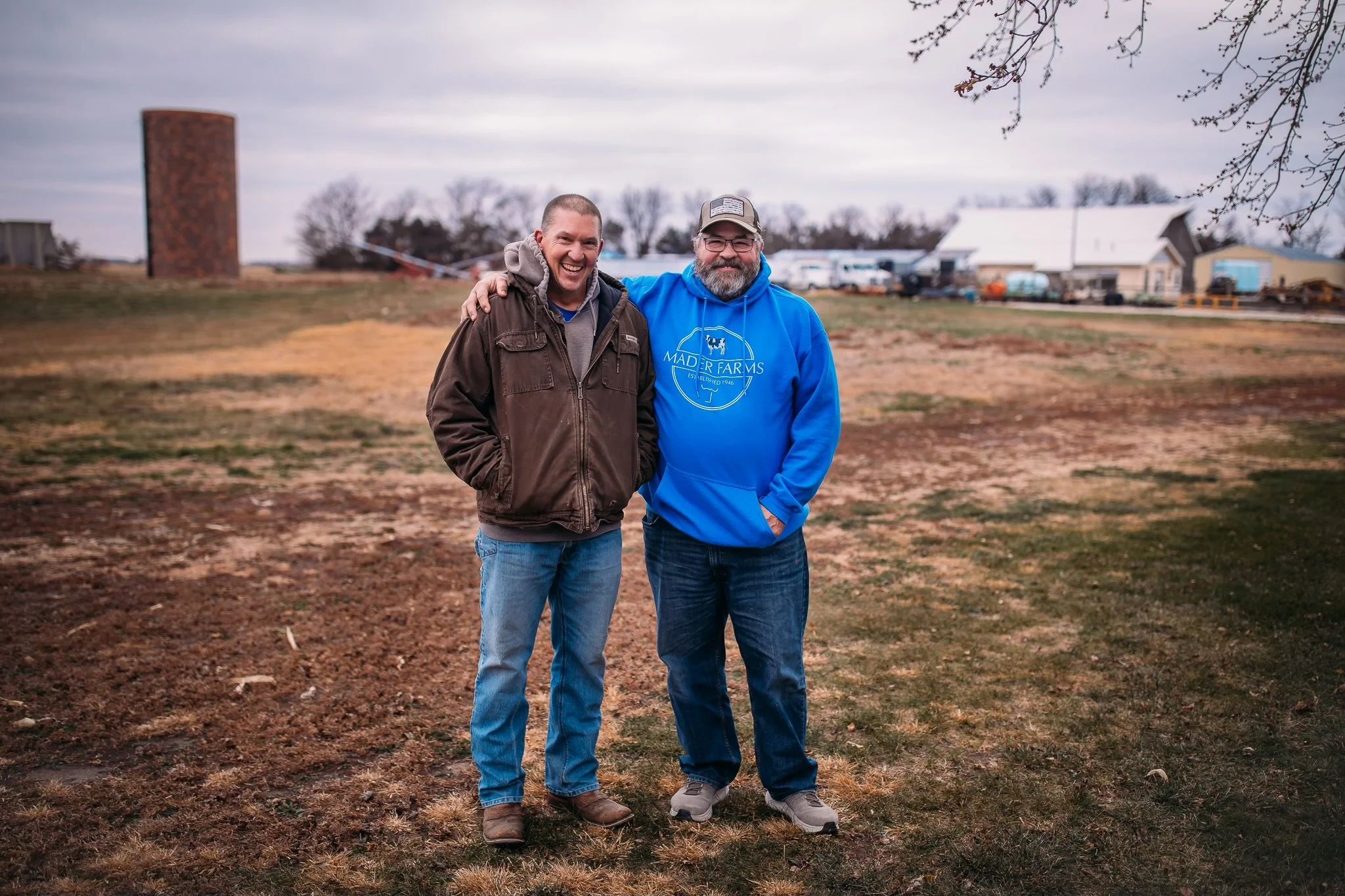
A conversation between Phil Mader (right) and his second cousin Zach Mader (left) who runs his operation on a neighboring Nebraska farm.
Just north of Grand Island, Nebraska, in the sweeping cropland of the Platte River basin, lie two branches of what was once one family farm. It’s a familiar story: generations ago, two brothers decided to go their separate ways, and one farm became two.
The eldest brother, my great-grandfather, was given the dairy operation, while his younger brother took the majority of the cropland. Today, the grandson of that youngest brother, Zach Mader, has been farming for over 26 years and works as a Producer Lead for the Nebraska Soil Health Coalition. The NSHC is a non-profit advancing producer-centered education, outreach, and adoption of soil health principles to build resilient farms, ranches, and communities across Nebraska. Learn more at www.nesoilhealth.org.
Across the fence is Phil Mader, my dad and grandson of the eldest, who has farmed for over 30 years. I am Phil's daughter and State Coordinator for the Nebraska Soil Health Coalition. Like many Nebraskans who live in cities (I now reside in Omaha), my connection to family members who farm and the land that raised us remains strong. Recently, I sat down with both Phil and Zach to hear their perspectives on regenerative agriculture and the dynamics that shape farm management decisions.
A Shared History
Casey (Interviewer): How are you two related, and what was farming like when you were growing up?
Phil: We didn't grow up together. Our grandfathers were 17 years apart in age. Eventually they split the land—we stayed on one half, and Zach's side got the north half. The dairy was on our side. We sold the cows around 25 years ago and switched to row corn only.
Zach: We were all corn on corn until we brought in soybeans about 10 or 15 years ago.
Different Approaches
Casey: Zach, can you describe your current operation?
Zach: I work in regenerative agriculture which focuses on restoring and improving the health of the soil. I use multiple crop rotations to feed soil biology and unlock nutrients like nitrogen and phosphorus that are already there. I focus on specialty markets and cleaning my own seed on-farm—things I can control. I plant everything untreated: no fungicides or pesticides. My goal is cutting costs and growing more with less.
Casey: Phil, how does Zach’s approach contrast with yours?
Phil: I’m more conventional. We rely more on synthetic fertilizers, pesticides, mechanization, and corn-soybean rotations. My generation has used research and technology to focus on yield—more yield meant success. I haven’t been entirely that way but I need proof before trying new things. One of my farms has been no-till for about 15 years.
Casey: So you're also trying to find a balance?
Phil: Yes, I've reduced nitrogen slowly over five years and I fertilize through the pivot for efficiency. Every year's different and Mother Nature is in charge ultimately.
Casey: Zach, what made you decide to come back and farm differently than the previous generations?
Zach: I don't see another way to bring my kids back without stacking enterprises and doing things differently than conventional farming. I'm not interested in farming 3,000 or 6,000 acres. I don't see the benefit.
Casey: Can you explain “stacking enterprises” a little more?
Zach: One example is grazing. I can utilize ground for the entirety of the year. In wintertime my livestock are grazing cover crops that I grew and feeding my soil with fertilizer. I have multiple ways to make money on one plot of land.
Relationships and Respect
Casey: How do relationships influence the decisions that you make?
Zach: Me, my brother and cousin still share equipment — we do everything together. But my land is mine to manage how I see fit, and there's no animosity. It works well, especially when you're spreading out large expenses.
Phil: I’ve had that too with my dad and now my son. You learn from each other, and it's okay to make mistakes.
Casey: Dad, what do you think of Zach’s regenerative approach?
Phil: I really respect it, and I would try new things if I had more time. There is no doubt that on my no-till plot the soil is better — you can see it. Ideally, everyone could make a living on 500 acres with more time and fewer hassles. Like Zach, I never wanted 5,000 acres and employees — just a good living doing what I want.
Leaving a Legacy
Casey: Farming isn't for the faint of heart. What keeps you both interested and passionate about your work?
Phil: It's building a legacy I can be proud of, for one.
Zach: Yes, legacy for sure. And I feel more full than ever — here (points to chest) and between here (points to head) — because I believe in what I’m doing. And in my space of regenerative ag, I get to meet some pretty cool people.
Part 2 of this interview “A Tale of Two Farms - Economics and the Future” forthcoming.
About the Nebraska Soil Health Coalition
We are a collaborative effort to increase sustainable agricultural production and thriving rural communities. As part of that vision, we support Nebraska’s community newspapers. Our mission is to advance producer-centered education, outreach, and adoption of soil health principles to build resilient farms, ranches, and communities across Nebraska.
