
Southwest Nebraska farmers explore soil health at coalition's organizational meeting in Imperial
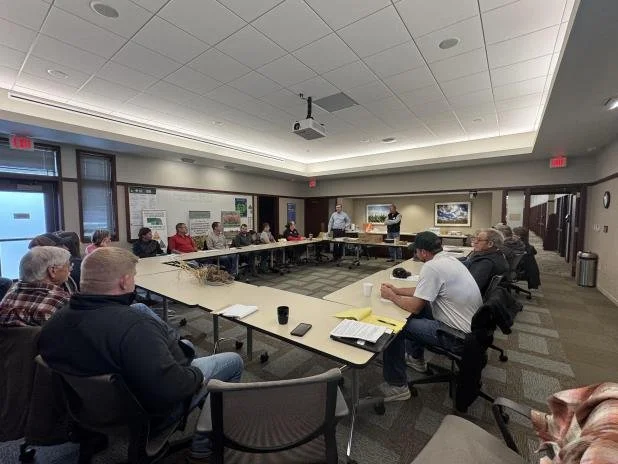
Jordan Uldrich, (first person at right in cap) producer lead for the newly formed Nebraska Soil Health Coalition, listens with other attendees as Mike McDonald opens the organizational meeting for the Southwest Hub of the coalition in Imperial last week.
Jordan Uldrich didn’t set out to become a spokesperson for soil health, but that is what he has found himself doing. As a producer lead for the newly formed Nebraska Soil Health Coalition, Uldrich was part of a recent Southwest Nebraska organizational meeting held in Imperial on Tuesday, March 10.
Uldrich, a fifth-generation farmer from the Milligan area in Fillmore County, first began experimenting with new farming practices a few years ago because of a growing problem on his own farm—weeds that were becoming harder and harder to control.
“I started doing soil health style farming because I was concerned about unmanageable weeds,” Uldrich said before the Imperial meeting, which was held at the Imperial Farm Credit Services building. “It became apparent that time is limited with using herbicides, so I started looking toward natural means of control.”
What started as a small experiment soon became something bigger. Uldrich began interseeding cover crops into corn fields—planting additional crops between the rows to help suppress weeds and improve soil health.
At first, he approached the idea cautiously.
“We started small,” he said. “I just did a couple strips through a field the first time. Then the next year I tried some plots, and by the third year I planted a 30-acre field.”
Today Uldrich farms with his father and brother near Milligan, growing corn, soybeans, milo and rye while raising a small beef herd. Their farm has also become a demonstration site for the Nebraska Soil Health Coalition, where producers experiment with practices such as cover crops, reduced tillage and rotational grazing.
Those experiences—and the potential he sees in them—are part of the reason Uldrich became involved with the Nebraska Soil Health Coalition, and why he is encouraging farmers in Southwest Nebraska to join the organization to explore soil-health practices.
“This is as grassroots as it can be,” he said about the coalition’s efforts to establish hubs across the state. “Guys like me aren’t trying to sell you anything. We’re trying to help other farmers realize the things we’ve learned.”
SW Nebraska Hub Organizational Meeting
The Nebraska Soil Health Coalition, formed in 2023 by farmers and agricultural leaders, aims to connect producers interested in improving soil health and strengthening rural communities. The coalition established its first regional hub in Hastings and is now expanding the model across the state, creating opportunities for farmers to share experiences and explore practices that improve soil productivity, conserve water and maintain long-term farm profitability. It was pointed out at the meeting that Southwest Nebraska was selected as the next hub in part because of the region’s water challenges, where farmers rely heavily on irrigation from the Ogallala Aquifer.
More than 20 farmers, agronomists, researchers and area community leaders gathered in Imperial to discuss soil health, a topic many of them said is becoming increasingly important to the future of ag in Nebraska.
The meeting provided an opportunity for producers to share experiences, discuss challenges and explore strategies that could help improve soil productivity while addressing concerns about water use, input costs and the long-term sustainability of farming operations.
While the discussions covered a wide range of topics—from cover crops and fertilizer use to water conservation and marketing opportunities—the underlying theme was clear—many producers believe improving soil health may be one of the most important steps toward ensuring the long-term viability of agriculture in the region.
Farmers experimenting with new approaches
Several producers at the meeting described experimenting with soil-health practices on their own farms, including Jake Miller of the Culbertson area, Chris Gertz and Michael Berg from the Ogallala region, and Sandhills rancher Mike Abbott.
Producers discussed efforts to reduce reliance on fertilizer and other agricultural inputs while maintaining crop productivity, and rebuild soil biology. One producer noted that his operation has experienced lower yields during the transition but believes the long-term benefits will outweigh the short-term challenges as soil organic matter improves.
Participants mostly agreed that improving soil health is a gradual process requiring patience and experimentation.
Balancing biology and chemistry
Throughout the meeting, participants discussed the challenge of balancing traditional agricultural practices with emerging soil-health strategies.
Several producers said they are searching for ways to maintain crop yields while reducing reliance on synthetic fertilizers. One agronomy professional said a key challenge for many farmers is finding ways to continue producing strong yields while applying fewer inputs and minimizing negative impacts on soil biology.
Water concerns driving interest
Water availability is another factor driving interest in soil-health practices.
Farmers in Southwest Nebraska operate in a region where groundwater from the Ogallala Aquifer is closely monitored. Producers said increasing soil organic matter can help soils absorb and retain moisture, potentially reducing irrigation needs and improving resilience during dry conditions.
Some farmers reported fields managed with soil-health practices appeared to require less irrigation than neighboring operations.
Challenges remain
Despite growing interest in soil health, producers acknowledged several barriers to adopting new practices.
Water limitations and degraded soils were among the most common concerns discussed. Participants also noted generational differences can complicate the adoption of new farming methods, with younger producers sometimes more willing to experiment than older generations.
Another challenge is the lack of information tailored to local conditions. Farmers said they often hear about successful soil-health practices in other regions but struggle to determine whether those practices will work in southwest Nebraska’s climate and soils.
Market opportunities also present challenges. Some farmers are exploring direct marketing of grass-fed beef or other products raised using regenerative practices, but finding customers willing to pay higher prices can be difficult.
The importance of community and collaboration
One goal of the meeting was to create opportunities for producers to connect and learn from one another.
Participants said many soil-health innovations are being developed directly by farmers rather than through traditional research channels. Sharing experiences with other producers can help identify practical solutions and reduce risks associated with experimenting with new practices. The meeting also touched on policy issues that affect soil-health practices.
Participants discussed how crop insurance rules can discourage the use of cover crops. One producer explained that planting a cover crop in certain situations can change how fields are classified for crop insurance, potentially lowering yield protection levels.
Several attendees said farmer organizations working together may have more influence when communicating with federal agencies and advocating for policy changes. Som participants emphasized the importance of maintaining local input in agricultural decision-making, saying rural communities should have a strong voice in shaping agricultural policy.
Looking ahead
Although soil-health practices are still evolving, many participants expressed optimism about their potential benefits. Several farmers said even small changes—such as adding cover crops, reducing tillage or adjusting fertilizer practices—can begin improving soil quality over time.
At the end of the meeting, Mike McDonald, a founding board member of the Nebraska Soil Health Coalition and moderator for the meeting, encouraged producers interested in soil health to stay involved as the coalition continues expanding its network of hubs across the state. McDonald said the coalition’s hub and cluster model is designed to connect farmers with similar interests—such as grazing, row crops and marketing—so they can share experiences and learn practical approaches from one another. Farmers or landowners interested in participating in future meetings or learning more about the coalition can visit www.nesoilhealth.org or email info@nesoilhealth.org.
Editor’s Note: Artificial intelligence tools were used to assist in the production of this story. All information was reviewed and verified by the writer prior to publication. The reporting and final writing of this article were completed by the reporter