Farmers focus on flexibility, alternative methods when planting in uncertain economy
Farmers across Nebraska are facing another year of planting into dust, but by diversifying their crops and staying flexible, farmers can make the most of it.
On Zach Mader’s farm north of Grand Island, the first week of April brought an inch of rain – the first significant moisture he’s seen since September.
“It was really welcome,” he said. “We’re very, very short right now.”
Mader, who serves as a producer lead for the Nebraska Soil Health Coalition, has the advantage of almost fully irrigated cropland, but he still plans for the worst.
At the end of March, he planted a little more than 100 acres of oats and peas. By April 10, the crop had just emerged. Without more moisture, the crops may not yield well enough to become cover crop seed like Mader intended.
“It doesn’t look super profitable,” he said.
Even if harvesting for seed is not possible, Mader knows the crop can still become good fodder for his cattle. At the very least, they’re a good ground cover and are feeding the soil, he said.
Growing crops other than input-heavy corn and soybeans may be wise at a time when war in the Middle East is driving up fertilizer prices and commodity prices are already low. Two University of Nebraska researchers suggest farmers consider planting a small portion of their fields to crops such as cereal millet, which yields big without needing much moisture, and field peas, which are gaining popularity in the health food world. Field pea, like millet, uses little water, and like soybeans, the crop fixes its own nitrogen.
“In years like this, even small shifts in cropping strategy can help protect both yield and profitability,” said Dipak Santra in a recent article from the University of Nebraska. Santra is an alternative crops breeding specialist for Nebraska Extension, based at the University of Nebraska-Lincoln Panhandle Research Extension and Education Center.
Both crops the Nebraska researchers suggested are good for the soil. Field peas enhance soil microbial activity. Millet increases organic matter, improves aggregation and reduces erosion.
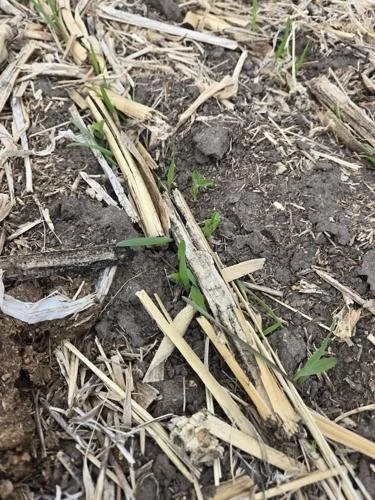
Oats and peas emerge through corn stubble in Zach Mader’s field north of Grand Island. He planted them in late March, and the area received much needed rain in early April.
Submitted photo by Zach Mader
Benchmarking against the best
Those soil qualities are among what the Nebraska Soil Health Coalition is measuring through its soil benchmarking program. The effort compares cropland under different management styles to the soils of native prairie. The long-range goal is to bring farming practices and the cropland they touch closer to functioning like nature intended.
Working with the University of Nebraska and funding through the Natural Resources Conservation Service, the coalition sampled eight new sites this spring. Those include six farm fields and two nearby native prairie sites, which serve as the benchmark for high-functioning soils.
A team from the university’s Panhandle Research and Extension Station at Scottsbluff, led by Dr. Bijesh Maharjhan, takes soil samples at each site and sends them to Ward Laboratories for an in-depth analysis. Farmers get a detailed report in addition to a summary of the most relevant data for managing their farm – for example, the percent of organic matter in their soils and the CO2 burst result, showing respiration or microbial activity.
This spring’s benchmark samples double the work already done last year, which included Mader’s farm. Comparing his cropland to native prairie, he was surprised how degraded his fields were, even after nearly 15 years of farming practices that are friendlier for soil health.
“I fall way short of the native soil,” he said.
In three to five years, the same sites will be sampled again. As farmers like him implement new practices and try to enhance soil health, Mader is interested in how the numbers will change. Some farmers in the sample are just starting to plant cereal rye as a cover crop, and others are switching to vertical tillage – practices meant to feed the soil, protect it from erosion and keep it from disturbing its structure.
“We think in three to five years we will see some measurable differences,” Mader said.
He’s especially looking forward to learning how different farming practices affect soil quality, such as one farm sampled this year near Clay Center, Nebraska. It uses lagoon water from a nearby hog operation on corn.
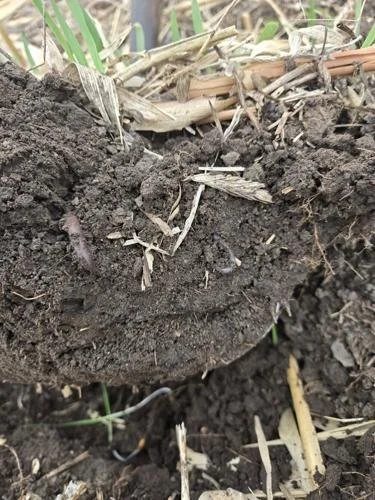
Earthworms peak out of a shovel full of soil from Zach Mader’s field. He and other producers have participated in a soil health benchmarking project, comparing their fields to native soil.
Submitted photo by Zach Mader
A different approach to fertilizer
In the last couple years on his farm, Mader has been working to use the “good stuff” in his own soil to enhance his crop. That “stuff” is indigenous microorganisms – bacteria and fungus that naturally grow in his soils. He essentially propagates that bacteria, makes a compost tea and uses it as a seed treatment.
“I’m inoculating those seeds with things that are native to my area,” Mader said.
He’s noticed healthy root systems in the plants he treats, and the soil seems to have more aggregation. Mader feels it’s a good fit for him. Because it’s a homemade treatment, it’s a cheap solution, and the process doesn’t take much of his time.
“I think it’s worth every penny,” he said.
It helps replace expensive synthetic fertilizer. He hasn’t used phosphorus on his farm for nearly 15 years. His nitrogen needs are on the very low end, about 50-80 pounds on a standard corn crop, Mader said.
What he does apply, he tries to time just right and get in just the right place. In furrow, he runs a carbon source like humic acid or folic acid, plus a little calcium. In season, he side-dresses nitrogen as needed, but most is fertigated through a pivot, applying five to 10 pounds per pass.
It’s working for Mader’s crop. He’ll find out what his efforts are doing to promote the health of his soils in the future through the coalition’s benchmarking project.
‘Round the NSHC Coffee Pot is a monthly feature special to the Midwest Messenger. It highlights the work of the Nebraska Soil Health Coalition, a nonprofit organization established in 2023 to advance producer-centered education, outreach, and the adoption of soil health principles to build resilient farms, ranches, and communities across Nebraska